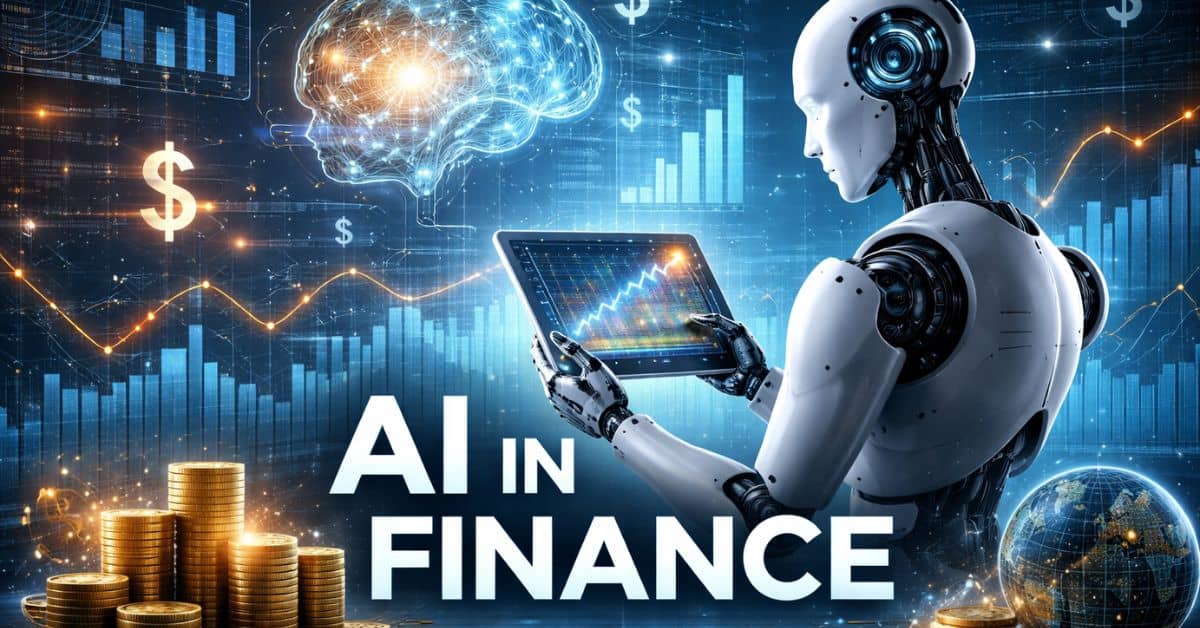
Imagine a world where financial decisions happen in the blink of an eye, fraud is spotted before it strikes, and personalized advice feels like it’s coming from a trusted advisor. That’s the reality AI in finance is creating today. As artificial intelligence integrates deeper into financial services, it’s reshaping how banks operate, investors trade, and consumers manage money. This article explores the core aspects of AI in finance, from its applications to future potential, highlighting why it’s a game-changer for the industry.
What Is AI in Finance?
Table of Contents
ToggleAI in finance refers to the use of advanced technologies like machine learning, natural language processing, and data analytics to handle financial tasks. At its heart, artificial intelligence in finance mimics human intelligence to process vast amounts of data quickly and accurately. Machine learning in finance, a subset of AI, allows systems to learn from patterns and improve over time without explicit programming.
These tools go beyond simple automation. They predict trends, assess risks, and even interact with customers. In essence, AI transforms raw data into actionable insights, making financial operations smarter and more efficient.
How AI Is Used in Finance
AI’s versatility shines in various financial domains. It streamlines processes, enhances security, and boosts customer experiences. Below, we break down key applications.
AI in Banking
In banking, AI powers everything from loan approvals to daily operations. Banks use AI algorithms to analyze customer data for personalized loan offers, speeding up approvals while reducing defaults. For instance, chatbots handle routine inquiries, freeing human staff for complex issues.
AI also optimizes back-office tasks like compliance checks and transaction monitoring. This leads to faster service and lower costs, making AI in banking a staple for modern institutions.
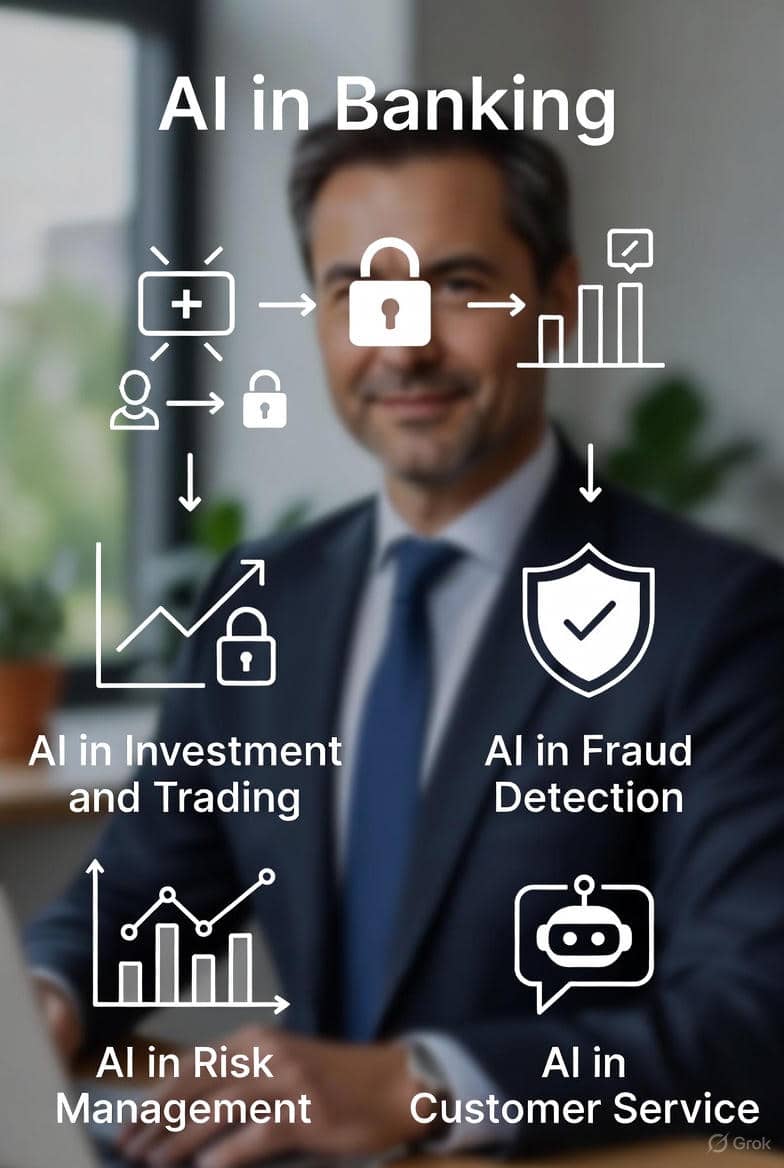
AI in Investment & Trading
AI trading has transformed markets by enabling high-frequency trades based on real-time data. Algorithms scan global news, social media, and economic indicators to predict stock movements. Robo-advisors, powered by AI, create tailored investment portfolios for individuals, democratizing access to wealth management.
In hedge funds, machine learning models forecast market volatility, helping traders make informed decisions. This precision gives AI in investment a clear edge over traditional methods.
AI in Fraud Detection
Fraudsters evolve, but AI fraud detection stays ahead. Systems monitor transactions in real time, flagging unusual patterns like sudden large transfers or logins from new locations. Machine learning refines these detections by learning from past incidents, reducing false positives.
Banks report significant drops in losses thanks to these tools. AI’s ability to process billions of transactions daily makes it indispensable for secure financial services.
AI in Risk Management
AI risk management involves assessing potential threats like credit defaults or market crashes. Advanced models crunch historical data, economic factors, and borrower profiles to score risks accurately. This helps lenders extend credit to underserved groups without increasing exposure.
In insurance, AI predicts claims based on weather patterns or customer behavior. Overall, it provides a proactive approach, minimizing losses in volatile environments.
AI in Customer Service (Chatbots, Personalization)
Customer service gets a boost with AI-driven chatbots that offer 24/7 support. These bots resolve issues like balance checks or payment disputes instantly. Personalization takes it further—AI analyzes spending habits to suggest budgeting tips or product recommendations.
This creates loyal customers by making interactions feel intuitive and helpful. In financial services, such tools enhance satisfaction while cutting operational expenses.
Benefits of AI in Finance
The advantages of AI in finance are profound and multifaceted. First, it drives efficiency by automating repetitive tasks, allowing teams to focus on strategic work. This results in cost savings, with some firms reporting up to 30% reductions in operational expenses.
Second, decision-making improves through data-driven insights. AI processes complex datasets to uncover trends humans might miss, leading to better investments and risk assessments. Fraud detection benefits immensely, as AI spots threats in milliseconds, protecting assets and building trust.
Additionally, customer experiences become more tailored. Personalized financial advice increases engagement and retention. In risk management, AI’s predictive power prevents crises, ensuring stability. Overall, these benefits position AI as a catalyst for innovation in financial services.
- Enhanced accuracy in forecasting and analytics
- Scalability for handling growing data volumes
- Improved regulatory compliance through automated reporting
Real-World Examples of AI in Finance
AI isn’t just theoretical—it’s in action across the sector. JPMorgan Chase employs AI for contract analysis, reviewing thousands of documents in seconds that once took lawyers hours. This speeds up deal-making and reduces errors.
In trading, firms like Renaissance Technologies use machine learning algorithms to execute trades based on predictive models, achieving superior returns. PayPal leverages AI fraud detection to scan over 10 million transactions daily, blocking suspicious activities in real time.
Banks such as Bank of America integrate AI chatbots like Erica, which assists millions with budgeting and bill payments. In risk management, BlackRock’s Aladdin platform uses AI to monitor portfolios for global clients, identifying risks across trillions in assets.
Fintech startups like Upstart apply AI in lending, approving loans for those with thin credit histories by analyzing alternative data. These examples show how AI in financial services delivers tangible results.
Challenges and Risks of AI in Financial Services
Despite its promise, AI in financial services comes with hurdles. Data quality issues can lead to flawed outcomes—if inputs are biased, decisions like loan approvals may unfairly disadvantage groups. Privacy concerns arise as AI handles sensitive information, requiring robust security to prevent breaches.
Regulatory compliance is another challenge. Governments are scrambling to set rules, but rapid AI evolution outpaces them, risking non-compliance fines. Cybersecurity threats intensify, as hackers target AI systems to manipulate data or outcomes.
Ethical dilemmas include transparency—users often can’t understand how AI reaches conclusions, eroding trust. Hallucinations, where AI generates false information, pose risks in high-stakes finance. Addressing these requires careful governance and ongoing audits.
Future of AI in Finance (2025 and Beyond)
Looking ahead to 2026 and beyond, AI in finance will evolve rapidly. Agentic AI, where systems act autonomously on tasks like portfolio adjustments, will become standard. Cloud-native solutions will enable seamless integration, enhancing fraud detection and personalization.
Workforce culture will shift, with AI augmenting roles rather than replacing them—finance pros will collaborate with AI for deeper insights. Embedded finance, blending services into non-financial platforms, will grow, powered by AI analytics.
Sustainability will factor in, with AI optimizing green investments. However, ethical AI frameworks will be crucial to mitigate risks. By 2030, AI could manage most routine financial tasks, freeing humans for innovation.
AI in Finance FAQs
What is AI in finance and how does it work?
AI in finance uses algorithms to analyze data for tasks like trading or fraud detection. It works by processing patterns in large datasets to make predictions or automate processes.
What are the main benefits of artificial intelligence in finance?
Key benefits include faster decision-making, cost reductions, enhanced security through AI fraud detection, and personalized services that improve customer satisfaction.
How is machine learning in finance applied to trading?
Machine learning in finance powers AI trading by predicting market trends based on historical data, news, and economic indicators, enabling automated and efficient trades.
What risks come with AI in risk management?
While effective, AI in risk management can amplify biases in data, leading to unfair assessments. It also raises privacy issues and requires strong oversight to avoid errors.
How will AI in banking change customer service in the future?
AI in banking will advance chatbots and personalization, offering proactive advice like spending alerts, making interactions more intuitive and available around the clock.
Conclusion
AI in finance is no longer a futuristic concept—it’s the driving force behind efficient, secure, and personalized financial services. From AI in banking to advanced risk management, its applications are vast and impactful. As we move into 2026 and beyond, embracing artificial intelligence in finance will unlock new opportunities, provided we navigate challenges wisely. The future promises a more inclusive and innovative financial landscape, where AI empowers everyone from investors to everyday consumers.