The Google Hummingbird Update was a major change to Google’s search system in 2013. It helped Google understand full questions better, not just single words.
This update focused on meaning and context. It made search results more helpful for users asking real questions.
The Google Hummingbird algorithm is still part of Google’s core system today in 2026. It started the move to semantic search and Hummingbird, where Google gets the intent behind words.
For SEO experts, the Hummingbird update SEO impact was huge. It shifted focus from stuffing keywords to creating good content.
This guide explains what it is, how it works, and tips for SEO after Hummingbird.
What Is the Google Hummingbird Update?
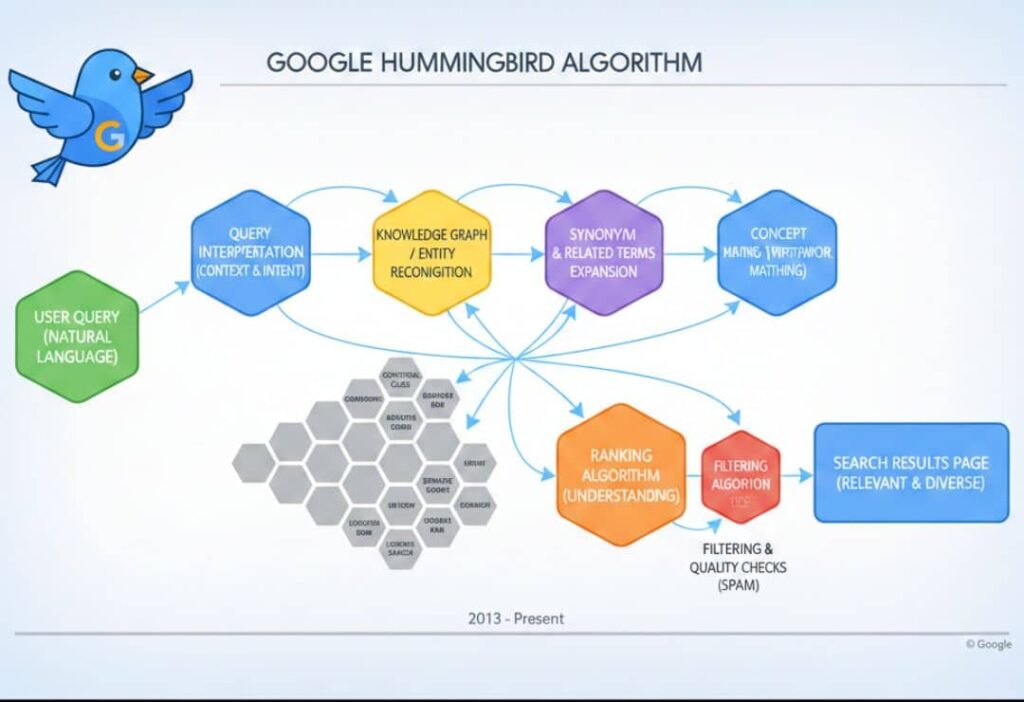
The Google Hummingbird Update is a full rewrite of Google’s search algorithm.
Unlike past updates that fixed parts, Hummingbird replaced the old engine. It kept good parts like Panda and Penguin but added new ways to understand queries.
Named for being fast and precise like a hummingbird, it handles natural language better.
It uses context to match queries to pages that fit the meaning, not just exact words.
When Was Hummingbird Launched and Why?
Google announced the Google Hummingbird Update on September 26, 2013, on its 15th birthday.
It was already running for a month before the announcement.
Why? Searches were changing. People used longer, conversational queries, especially on mobile and voice search.
Old systems focused on keywords. Hummingbird was built for meaning and intent.
It prepared Google for future features like voice assistants.
Key Features of the Hummingbird Update
Hummingbird has several important features.
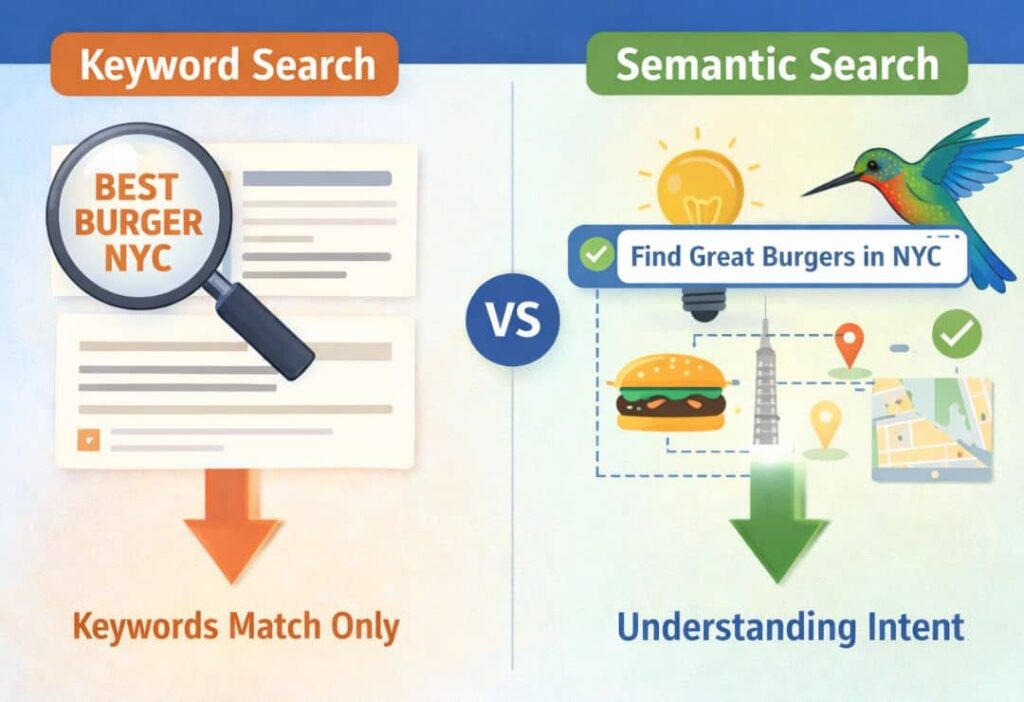
First, semantic search and Hummingbird. It understands synonyms and related ideas.
Second, it focuses on search intent. What does the user really want?
Third, better query interpretation. It handles complex questions well.
- Conversational searches like “best Italian restaurant near me” get local results.
- It uses the Knowledge Graph for facts about people, places, and things.
- Supports long-tail keywords naturally.
These make results more accurate.
How the Hummingbird Update Impacts SEO
The Hummingbird update SEO impact changed strategies forever.
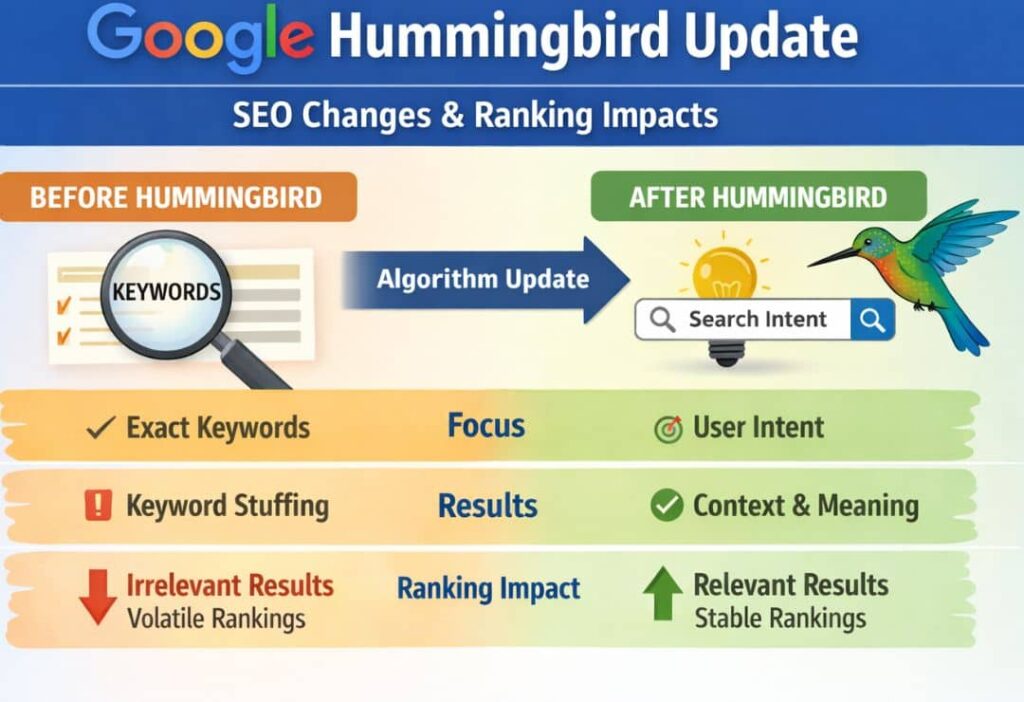
Keyword stuffing stopped working. Exact matches are less important.
Now, focus on long-tail keywords that match real questions.
Content quality over quantity. Write helpful, in-depth articles.
The shift to user intent means create content that answers needs.
Sites with thin content dropped. Good, relevant pages rose.
Benefits of Adapting SEO to Hummingbird
Adapting to SEO after Hummingbird brings many wins.
Better rankings for conversational searches.
More traffic from voice and mobile users.
Higher user satisfaction leads to longer visits and shares.
Stronger brand as a helpful source.
Real-World Examples of Hummingbird’s Impact
Here are some examples.
Before: Search “acid reflux prescription” showed drug lists.
After: It shows info on treatments and lifestyle changes.
Another: “pay taxes to the IRS” now links directly to the payment page.
Conversational query: “What is the best family SUV under $30,000?” gets reviews and comparisons.
These show how Hummingbird understands full meaning.
Sites with topic-focused content rank better for related terms.
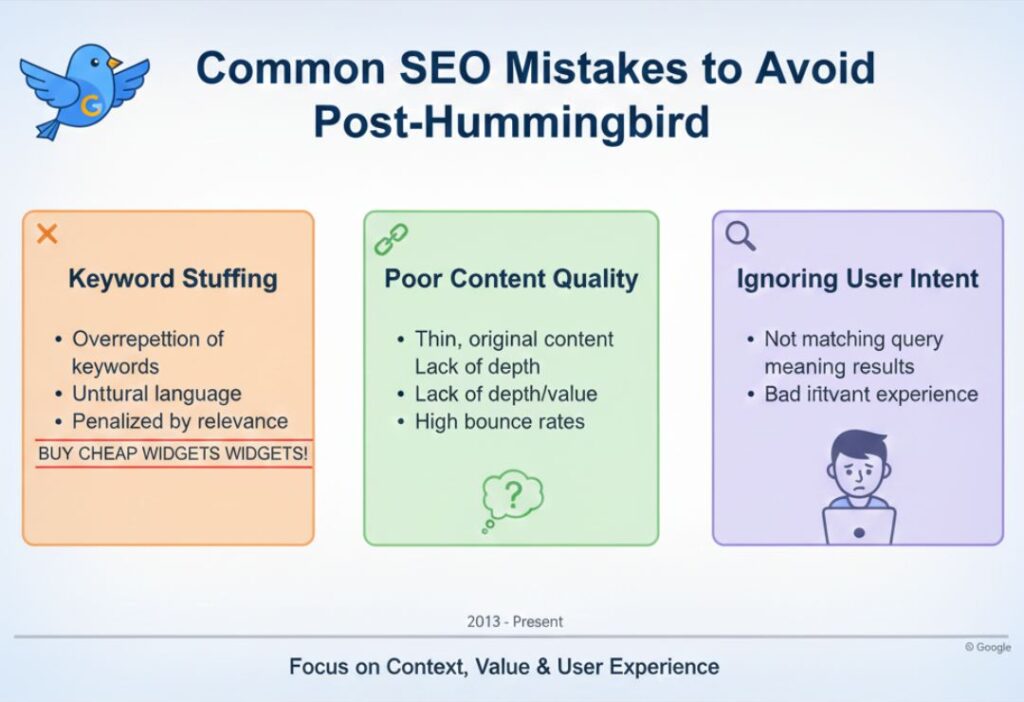
Common SEO Mistakes to Avoid Post-Hummingbird
Avoid these errors after the update.
Don’t over-use exact keywords.
Skip creating pages for every small variation.
Don’t make short, low-value content.
Ignore mobile and voice optimization.
Forget about user experience.
Focus only on links, not content depth.
Fix these for better results.
Future of SEO After Hummingbird and Similar Updates
Hummingbird started trends that continue in 2026.
AI and updates like BERT build on it for even better understanding.
Expect more focus on entities and relationships.
Voice search and featured snippets will grow.
Google search updates will reward helpful, people-first content.
Stay ready by monitoring changes and testing.
FAQs About Google Hummingbird Update
What exactly is the Google Hummingbird algorithm?
It is a 2013 overhaul that focuses on understanding query meaning and intent, not just keywords.
When was the Google Hummingbird Update released?
Announced in September 2013, but active since August 2013.
How did the Hummingbird update SEO impact change strategies?
It moved focus to semantic search, quality content, and user intent over keyword density.
Is semantic search and Hummingbird still important today?
Yes, it forms the base for modern Google search, including AI features.
What are good SEO practices after Hummingbird?
Create helpful content, target long-tail queries, optimize for intent, and improve user experience.
Conclusion
The Google Hummingbird Update transformed search by prioritizing meaning and intent.
From 2013 to now, its effects shape Google algorithm updates.
For strong SEO, embrace SEO after Hummingbird principles.
Focus on users, make great content, and think about full questions.
This way, your site will do well in future Google search updates. Stay updated and adapt for success.